Last Updated: April 2026 | Category: Financial Security | Reading Time: 8 minutes
Introduction
According to the Nigeria Inter-Bank Settlement System (NIBSS), digital payment fraud amounting to N25.85 billion occurred in 2025, and while that figure is down from N52.26 billion in 2024, online fraud in Nigeria remains a serious and growing threat. In 2026, scammers are more sophisticated than ever, using artificial intelligence, deepfake videos, and highly convincing cloned websites to steal from unsuspecting Nigerians. This guide explains the most common fraud types you will encounter and the practical steps you can take to stay safe.
The Current State of Online Fraud in Nigeria (2026)
Nigeria’s rapidly growing digital payments ecosystem worth an estimated $10 billion in fintech transactions, has unfortunately attracted a parallel ecosystem of fraudsters. The SEC has noted that Nigerians lost an estimated N300.2 billion to fraudulent investment schemes in recent years. Nigeria’s cryptocurrency market reached $92.1 billion in transactions in January 2026 alone, making crypto fraud a particularly pressing concern. Globally, the FBI Internet Crime Report consistently ranks Nigeria among the top 20 countries most affected by cybercrime.
Meanwhile, AI tools have given scammers a powerful new weapon. In early 2026, prominent Nigerians, including Ibukun Awosika and Ngozi Okonjo-Iweala, were forced to publicly debunk AI-generated deepfake videos showing them endorsing fraudulent investment platforms. Fraud is no longer just emails from “Nigerian princes”; it is sophisticated, targeted, and increasingly difficult to detect without awareness.
Most Common Online Payment Fraud Types in Nigeria (2026)
1. Phishing (Fake Bank Websites and SMS)
Phishing involves fraudsters sending fake emails, SMS messages, or social media posts pretending to be from trusted organisations — your bank, FIRS, CBN, or a popular fintech. The goal is to trick you into clicking a link that takes you to a fake website designed to steal your login credentials, card details, or BVN. In recent cases, scammers have cloned the websites of banks, including major institutions and Moniepoint, creating near-perfect replicas to harvest user data.
2. AI-Generated Deepfakes and Celebrity Scams
Using widely available AI tools, fraudsters create convincing videos of trusted celebrities and public figures appearing to endorse investment platforms or government giveaways. These videos circulate on Facebook, Instagram, TikTok, and WhatsApp. If you see a video of a well-known personality promoting a financial product, treat it with extreme suspicion and verify directly through that person’s official, verified accounts.
3. Fake Investment Platforms (Ponzi Schemes)
These platforms promise unrealistic returns: “double your money in 30 days,” “earn 50% monthly returns” and initially pay out small amounts to build trust before disappearing with depositors’ funds. In February 2026, Nigerian police arrested seven suspects running an online investment scam centre specialising in crypto fraud, who had used 500 social media accounts to recruit victims. The SEC has repeatedly warned against investing in unlicensed crypto and forex platforms.
If you are looking for legitimate ways to invest, read “How Nigerians Can Invest in US Stocks (Step-by-Step Guide 2026)” and “Best Investment Apps in Nigeria for Beginners.”
4. Card Skimming and ATM Fraud
Fraudsters attach physical skimming devices to ATM machines or POS terminals to capture card data. A hidden pinhole camera records the PIN being entered. The combination allows them to clone your card and drain your account. This type of fraud is particularly common at poorly monitored ATMs in high-traffic areas.
5. Employment Scams
Fake job ads often clone government agency or corporate websites, promise well-paying jobs and ask applicants to pay “registration fees,” “training fees,” or submit bank card details through a fraudulent payment portal. As unemployment remains a significant challenge in Nigeria, these scams exploit desperation and hope.
6. Romance Scams
Fraudsters create fake personas on dating apps and social media, build trust over weeks or months, and then fabricate emergencies requiring money transfers. Nigeria has been identified as a major source of romance scams globally, with victims losing hundreds of thousands of dollars. Most victims do not report these incidents due to embarrassment.
7. Fake Customer Service Accounts
Scammers create fake bank or fintech support accounts on X (Twitter) and WhatsApp that reply to customers seeking help. When you tweet at your bank complaining about a transaction, a fake account may respond, direct you to a fraudulent link, and steal your details. One Nigerian lost $1,500 to a fake UBA account operating this way.
If you ever face transaction issues, see “What To Do If Money Is Debited But Not Received in Nigeria.”
8. P2P Crypto Scams
In peer-to-peer crypto trading, fraudsters send fake payment screenshots to “prove” they have transferred money for crypto, then demand that the crypto be released before the real transfer is made. Another variant involves the EFCC risk: a buyer pays with naira from a compromised account linked to fraud, and the trader’s bank account gets frozen even though they were an innocent party.
10 Proven Ways to Protect Yourself from Online Fraud in Nigeria
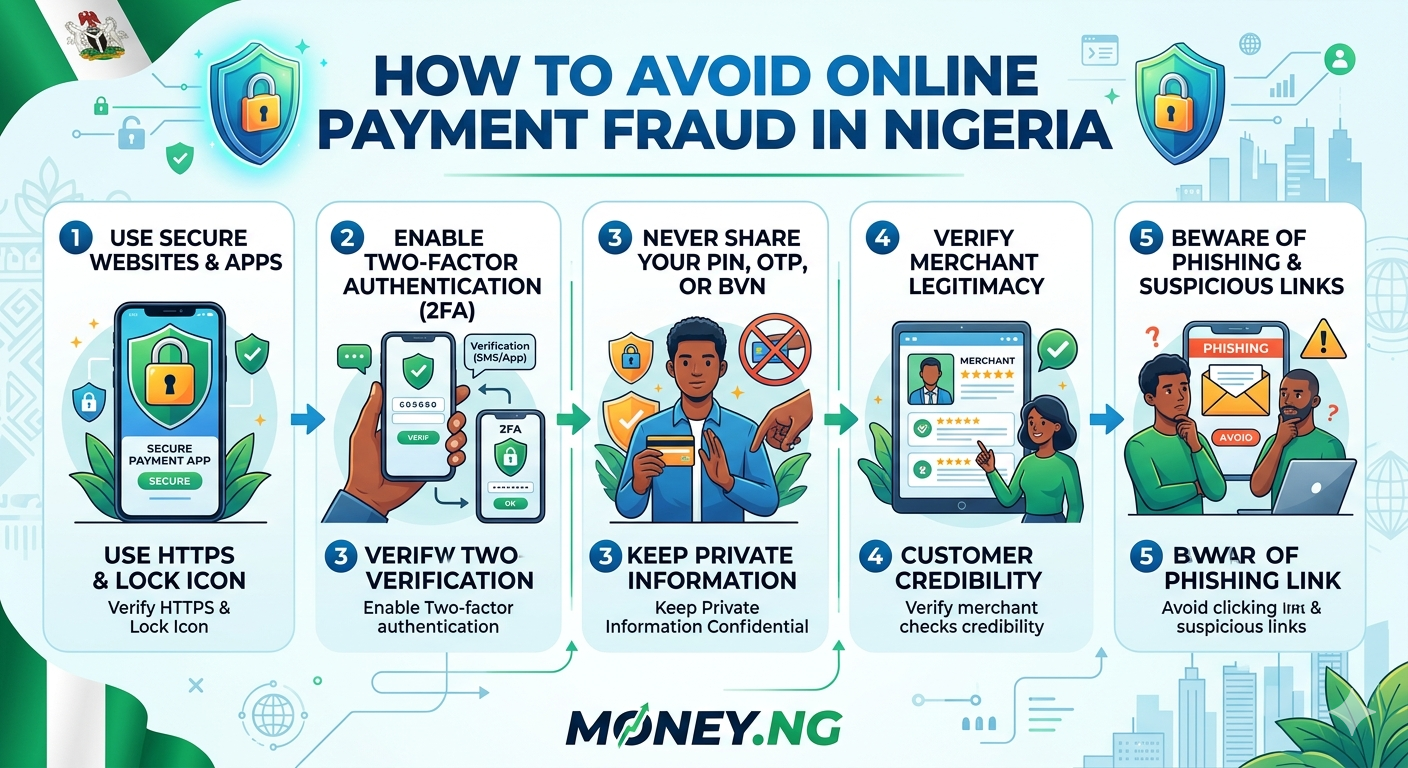
1. Enable Two-Factor Authentication (2FA) on All Accounts
Set up 2FA on your mobile banking apps, email, and fintech accounts. This means even if a fraudster has your password, they cannot access your account without a second verification code sent to your registered phone or email.
2. Verify Before You Trust
Before clicking any link, responding to any financial request, or making any payment, independently verify the source. Call your bank on its official number (not a number provided in the suspicious message). Check that a website’s URL matches the official domain exactly — fraudsters use tiny variations like “gtbankk.com” instead of “gtbank.com”.
No legitimate bank, fintech, or government agency will ever ask for your Bank Verification Number (BVN), account PIN, or one-time password (OTP) over the phone, via SMS, email, or social media. If anyone asks for these details, end the conversation immediately and report it.
To understand how BVN works, read “How to Check BVN Online in Nigeria (Step-by-Step Guide).”
4. Use Strong, Unique Passwords
Use a different password for every financial account. Avoid easily guessable passwords like your date of birth, phone number, or “password123.” A password manager like 1Password or Bitwarden can help you generate and store complex passwords securely.
5. Only Use CBN-Licensed Platforms
Before depositing money into any investment or fintech platform, verify its licensing status on the CBN website (cbn.gov.ng) or the SEC Nigeria website (sec.gov.ng). Unregistered platforms have no legal obligation to return your funds and are outside the reach of Nigerian regulators.
6. Reject “Too Good to Be True” Returns
Any investment promising returns above 20–30% per month, guaranteed profits, or risk-free earnings is almost certainly a scam. Legitimate investments carry risk and provide returns that roughly correspond to prevailing market rates. When in doubt, walk away.
7. Inspect ATMs Before Use
Before inserting your card at an ATM, check for unusual attachments on the card slot or keypad. Wiggle the card reader legitimate card readers are firmly attached. Cover the keypad with your hand when entering your PIN. Use ATMs in well-lit, high-security locations where possible.
8. Report Fraudulent Accounts Immediately
If you encounter a suspicious social media account, fake website, or fraudulent investment platform, report it to the Economic and Financial Crimes Commission (EFCC) through their website or the toll-free hotline 0800-2255-3322. Also, report to your bank’s fraud desk immediately if you suspect your account has been compromised.
9. Regularly Check Where Your Photos Appear Online
With AI tools making identity theft easier, periodically use reverse image search to check if your photos have been stolen for fake accounts. If you find fraudulent accounts impersonating you, report them to the platform and the EFCC immediately.
10. Educate Your Family and Circle
Most fraud victims are not unintelligent; they are simply uninformed. Share knowledge about common scams with your parents, siblings, and friends, especially those who are new to digital banking. Community awareness is one of the most effective defences against fraud at scale.
What to Do If You Have Been Scammed
If you suspect you have been defrauded online, act immediately. Contact your bank’s 24/7 fraud line and request that any pending transactions be blocked or reversed. File a complaint with the EFCC Cybercrime Unit and gather all available evidence, screenshots, transaction receipts, and chat records. Report the incident to NIBSS through their fraud portal. Time is critical: the faster you report, the higher the chance of recovering funds or preventing further losses.
Frequently Asked Questions (FAQs)
How common is online payment fraud in Nigeria?
According to NIBSS data cited earlier, digital payment fraud runs into tens of billions of naira annually, making it a widespread and serious issue.
What is the most common type of online fraud in Nigeria?
Phishing, fake investment platforms, and fake customer service accounts are among the most common fraud types Nigerians encounter.
Can I recover money lost to online fraud?
Recovery depends on how quickly you act. Contacting your bank immediately and reporting to EFCC improves your chances significantly.
How can I verify if an investment platform is legitimate?
You should confirm registration with the Central Bank of Nigeria (CBN) or the Securities and Exchange Commission (SEC) Nigeria before investing.
Is it safe to use online banking in Nigeria?
Yes, online banking is safe if you follow best practices such as enabling 2FA, avoiding suspicious links, and using only trusted platforms.
Conclusion
Online fraud is not going away in 2026; if anything, the tools available to scammers are becoming more powerful. But awareness is your strongest shield. Know the warning signs, protect your credentials, and verify everything before you transact. Your naira is hard-earned; it deserves strong protection.
Disclaimer
Disclaimer: This article is for informational purposes only. If you have been a victim of fraud, contact the EFCC, your bank, and relevant authorities immediately.