Last Updated: March 2026 | Category: Money Transfers | Reading Time: 9 minutes
Introduction
Whether you are paying school fees in the UK, supporting a family member in Canada, settling invoices with an overseas supplier, or funding a foreign investment account, sending money abroad from Nigeria is a common and frequently confusing task. Exchange rates, hidden fees, CBN limits, and unreliable transfer times can turn a simple transaction into a frustrating ordeal. This guide cuts through the noise, explaining the best platforms, the required documents, CBN regulations, and a clear step-by-step process for international money transfers from Nigeria in 2026.
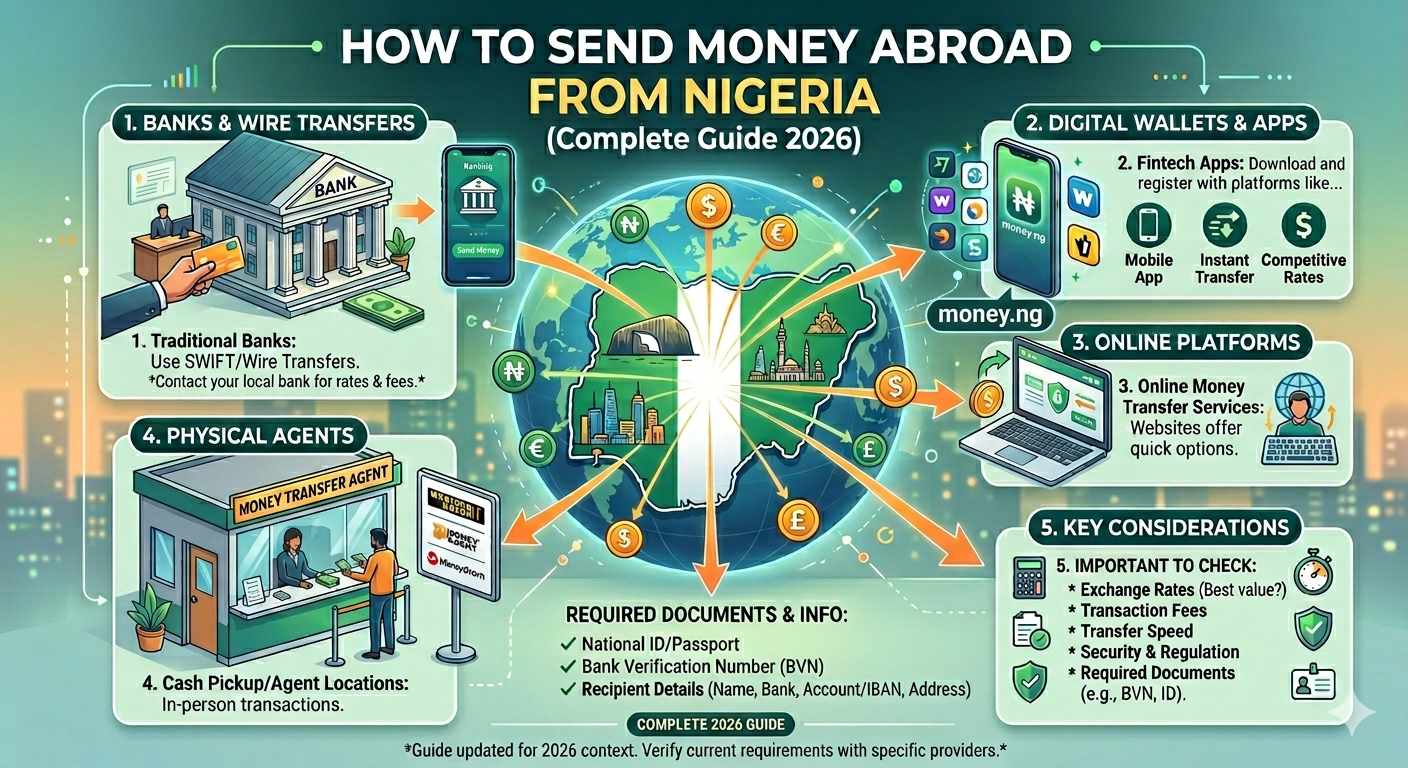
Methods for Sending Money Abroad from Nigeria
1. Fintech Transfer Apps (Fastest and Cheapest)
The most efficient way to send money abroad from Nigeria in 2026 is through dedicated fintech transfer platforms. These apps offer competitive exchange rates, transparent fees shown upfront, and transfer speeds ranging from minutes to one business day, far better than traditional banks. Below are the top platforms Nigerians use in 2026.
2. Bank Wire Transfer (Traditional)
You can send money overseas through a wire transfer from a commercial Nigerian bank to the recipient’s bank abroad. This requires either a domiciliary account (a Nigerian bank account that holds foreign currency) or a standard naira account with a bank that processes international transfers. Bank wire transfers take 2–5 business days and carry higher fees than fintech alternatives, but are preferred for large, corporate, or very high-value transfers.
If you do not have one, read “How to Open a Domiciliary Account in Nigeria (Dollar, Pound & Euro).”
3. Money Transfer Operators (Western Union, MoneyGram)
Established agents like Western Union and MoneyGram offer cash pickup options in the destination country, making them useful when the recipient does not have a bank account. They are widely available in Nigeria through bank partnerships, and their compliance programs are mature. However, their exchange rates and fees are often less competitive than those of modern fintech apps.
Best Platforms to Send Money Abroad from Nigeria (2026)
Wise (Best for Transparency)
Wise is widely regarded as the gold standard for transparent international money transfers. It uses the real mid-market exchange rate, the same rate you see on Google, and charges a small, clearly displayed fee before you confirm any transfer. For Nigerian users, Wise supports sending to international accounts and receiving in naira via bank transfer. Wise also offers a multi-currency account, making it particularly useful for freelancers and remote workers who earn in USD or GBP and need to hold or convert funds. Around 74% of Wise transfers arrive in under 20 seconds.
LemFi (Best for UK and US Corridor)
LemFi has become a favourite for international money transfers in Nigeria, particularly for those sending GBP from the UK or USD from the US to Nigerian accounts. It offers competitive Naira rates, a clean app interface, and strong Trustpilot ratings. LemFi also allows users to create virtual foreign accounts (USD, GBP, and EUR IBANs) that can be shared with international clients or employers.
Grey Finance (Best for Receiving International Payments)
Grey is designed specifically for global professionals, remote workers, and freelancers in Nigeria who need to receive payments from international clients and employers. With Grey, you can open a USD, GBP, or EUR account in your name and receive payments directly from platforms like PayPal, Payoneer, and global employers and locations. For a deeper guide, read “How Nigerians Can Receive Foreign Payments Without Issues.”
Remitly (Best for Speed Options)
Remitly offers two transfer speed tiers: Express (instant delivery) and Economy (cheaper but takes 3–5 business days). Both show fees and exchange rates upfront. Remitly supports transfers to Nigerian bank accounts, mobile wallets, and cash pickup locations and provides real-time transfer tracking.
WorldRemit (Best Multi-Option Platform)
WorldRemit supports NGN transfers to bank accounts, cash pickup locations, and mobile wallets, including OPay and PalmPay. It occasionally offers promotional reduced-fee transfers on select routes. The platform covers 130+ countries, and 90% of transfers to Nigeria are processed within minutes once payment is confirmed.
Sendwave (Best for Zero-Fee Transfers)
Sendwave is particularly popular among Nigerians in the diaspora sending money home. It charges zero transfer fees on many routes and delivers directly to mobile wallets like OPay and PalmPay within minutes. However, note that Sendwave is primarily designed for transfers into Nigeria, not outbound transfers from Nigeria.
Step-by-Step: How to Send Money Abroad from Nigeria
Step 1: Choose Your Platform
Select a platform based on your destination country, transfer amount, required speed, and whether your recipient needs cash or a bank deposit. For most Nigerians sending money to the UK, US, or Europe, Wise or LemFi offers the best combination of rate and reliability.
Step 2: Create Your Account and Complete KYC
Register with your full name, email, phone number, and license ID or government-issued ID (NIN, international passport, or driver’s license). For higher transfer amounts, some platforms require proof of address. KYC verification typically takes a few minutes to a few hours.
Step 3: Prepare Your Documents
For the transfers through a Nigerian commercial bank, you will typically need the recipient’s full name, bank name, account number or IBAN, SWIFT/BIC code, bank address, and the purpose of the transfer (e.g., school fees, personal support, or business payment). Fintech apps typically require only the recipient’s bank account details or phone number.
Step 4: Check the Exchange Rate and Fees
Always compare the total cost of a transfer; this means the transfer fee plus the exchange rate margin. A platform advertising “zero fees” may be recovering its revenue through a less favourable exchange rate. Use Wise’s fee calculator or the platform’s comparison tool to see exactly how much your recipient will receive in their currency before confirming.
Step 5: Fund and Send
Fund your transfer via a Nigerian bank transfer, debit carefully, from your platform wallet balance. Confirm all recipient details carefully; most platforms cannot reverse a transfer once it has been sent. Initiate the transfer and save your transaction reference number.
Step 6: Track Your Transfer
Most modern fintech platforms provide real-time tracking with push notifications when funds are delivered. Keep your reference number safe until the recipient confirms receipt.
CBN Regulations and Limits (2026)
The Central Bank of Nigeria regulates outbound money transfers through its foreign exchange guidelines. As of 2026, personal account holders typically face monthly forex transfer limits ranging from $5,000 to $10,000 per month, depending on the platform and account verification tier. Corporate accounts and domiciliary accounts may have higher limits. Always confirm your specific limit with your chosen bank or platform before initiating large transfers, as exceeding limits without proper documentation results in delayed or blocked transactions.
Only use platforms authorised by the CBN for international money transfers. Using unlicensed services puts your money at risk with no legal recourse if something goes wrong.
Tips to Get the Best Exchange Rate
Monitor the naira/dollar rate before initiating large transfers; rates fluctuate daily. Some platforms allow you to lock in an exchange rate for a limited period, protecting you from adverse movements. Avoid transferring on Fridays or the eve of public holidays when banks may process transactions slowly. Consider holding funds in a domiciliary account and converting when the rate is favorable rather than converting at the point of every transfer.
Protecting Yourself from Transfer Fraud
The remittance space attracts fraudsters. Only use CBN-licensed or internationally reputable platforms. Never share your BVN, NIN, or bank PIN with any third party; no legitimate transfer service will ask for these.
For more safety tips, read “How to Avoid Online Payment Fraud in Nigeria (2026 Guide).”
Also see “Common Financial Scams in Nigeria and How to Avoid Them.”
Frequently Asked Questions (FAQs)
What is the cheapest way to send money abroad from Nigeria?
Fintech apps like Wise and LemFi are generally the cheapest due to transparent fees and better exchange rates.
How long do international transfers take from Nigeria?
Transfers can take from a few minutes to 5 business days, depending on the method and platform used.
Do I need a domiciliary account to send money abroad?
Not always. Many fintech platforms allow you to send money directly from your Naira account without a domiciliary account.
What is the transfer limit from Nigeria?
Most individuals can transfer between $5,000 and $10,000 monthly, depending on the platform and verification level.
Is it safe to send money abroad from Nigeria?
Yes, as long as you use regulated platforms and verify recipient details carefully before sending.
Conclusion
Sending money abroad from Nigeria has never been easier or more affordable, thanks to the proliferation of regulated fintech platforms with transparent pricing. The key is choosing the right platform for your specific corridor, checking the all-in cost (not just the headline fee), and ensuring your recipient’s details are accurate before sending. With the right tools, international money transfer from Nigeria is as simple as a few taps on your phone.
Disclaimer
Disclaimer: Exchange rates and fees change frequently. Always verify current rates on the platform’s website or app before initiating any transfer. This article is for informational purposes only and does not constitute financial advice.