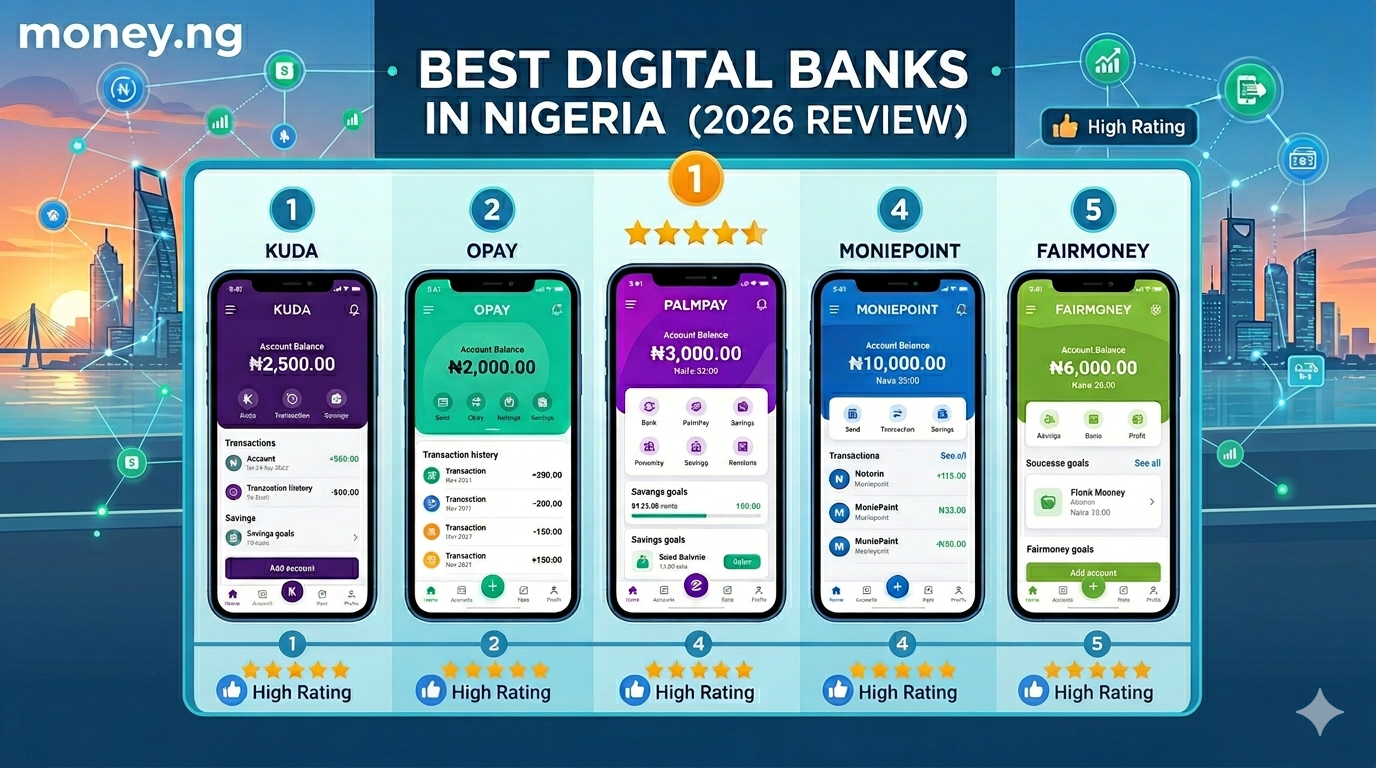
Nigeria’s digital banking revolution has transformed how millions of people manage their money. With over 35 million Nigerians using OPay alone and Kuda processing more than ₦14 trillion in transactions in 2025, the traditional model of queuing at physical bank branches is rapidly being replaced by fast, app-based financial solutions.
But with so many options available in 2026, the key question remains: which digital bank is actually best for you?
This review breaks down Nigeria’s top digital banks and mobile money platforms, analyzing their fees, features, reliability, security, and ideal use cases so you can make an informed decision.
What Is a Digital Bank in Nigeria?
A digital bank (also known as a neobank or fintech bank) is a financial institution that operates primarily through a mobile app or web platform, with little to no physical branch presence.
In Nigeria, digital banks typically operate under the following:
- CBN microfinance banking licences, or
- Mobile Money Operator (MMO) licenses
Most are insured by the Nigeria Deposit Insurance Corporation (NDIC), meaning your deposits are protected up to regulatory limits.
Key advantages of digital banks:
- Faster account opening (minutes, not days)
- Lower or zero transaction fees
- Innovative tools (budgeting, savings automation, analytics)
- 24/7 accessibility via smartphone
Best Digital Banks in Nigeria (2026)
1. OPay — Best for Everyday Payments and Reliability
OPay has evolved into one of Africa’s most powerful financial super-apps, serving over 35 million users and more than one million SMEs.
It is widely regarded as the most reliable digital payment platform in Nigeria, with near-perfect transaction success rates—even during downtime experienced by traditional banks.
Its massive POS agent network ensures easy cash-in and cash-out access nationwide, including semi-urban areas.
OPay also offers:
- OWealth savings: up to 15% annually (credited daily)
- Fixed savings: 15–18% annually
- Clean, functional interface focused on core banking
Best for: Everyday users, traders, SMEs, and anyone prioritising reliability
Limitation: The interface is less polished than some competitors
2. Kuda Bank — Best for Clean Banking and Free Transfers
Kuda is Nigeria’s first fully digital microfinance bank, popularly known as “the bank of the free.”
It eliminates most traditional banking charges, offering the following:
- 25 free transfers monthly
- Zero maintenance fees
- Clean, intuitive user experience
Kuda also includes:
- Automatic expense categorisation
- Savings goals and automation
- “Spend and Save” feature
- Overdraft access for eligible users
- US stock investing integration
Best for: Salaried workers, students, and users who want simplicity + budgeting tools
Limitation: Customer support can be slow during peak demand
3. PalmPay — Best for Rewards and First-Time Users
PalmPay has achieved massive adoption, with 15 million daily transactions and strong penetration among first-time bank users.
Its biggest strength is its reward system, offering the following:
- Cashback on airtime and data
- Discounts on bill payments
- Merchant rewards
It is also pre-installed on many smartphones (Tecno, Infinix), making onboarding easy.
Best for: Beginners, students, and heavy airtime/data users
Limitation: The interface can feel cluttered with promotions
4. Moniepoint — Best for Business Owners and Reliability
Moniepoint is Nigeria’s first digital banking unicorn, processing over 800 million monthly transactions.
Originally built for businesses, it is known for:
- Extremely high transaction reliability
- Strong POS infrastructure
- Business tools (invoicing, loans, account management)
It also supports personal banking with free transfers and wide ATM access.
Best for: Business owners, POS agents, traders
Limitation: Personal banking UI is less refined
5. ALAT by Wema — Best All-Round Digital Banking Experience
ALAT combines fintech innovation with the stability of a licensed commercial bank (Wema Bank).
Features include:
- Savings and budgeting tools
- Joint and children’s accounts
- Instant loans
- Virtual dollar cards
- Cross-platform support (web + mobile)
Best for: Professionals, families, users wanting a full banking suite
Limitation: Occasionally slower app performance
6. Sparkle — Best for Freelancers and Small Businesses
Sparkle is designed as a lifestyle bank for freelancers and entrepreneurs.
It offers:
- Bookkeeping tools
- Expense tracking
- Invoicing features
- Financial insights
This makes it ideal for users who want banking + business management in one place.
Best for: Freelancers, creatives, SMEs
Limitation: Smaller ecosystem and agent network
7. Carbon — Best for Digital Lending
Carbon started as a lending platform and has evolved into a full digital bank.
Its strength lies in:
- Instant, collateral-free loans
- Integrated savings and payments
- Insurance services
Best for: Users who need access to credit
Limitation: Lower savings returns compared to competitors
Side-by-Side Comparison (Quick Summary)
- OPay: Reliability + savings
- Kuda: Clean UX + free banking
- PalmPay: Rewards + accessibility
- Moniepoint: Business + uptime
- ALAT: Full-service banking
- Sparkle: Freelancers + SMEs
- Carbon: Lending + credit access
Are Digital Banks Safe in Nigeria?
Yes—if you use licensed platforms.
Most reputable digital banks:
- Are regulated by the Central Bank of Nigeria (CBN)
- Have NDIC insurance coverage
- Use advanced security (2FA, biometrics, encryption)
To stay safe:
- Enable all security features
- Never share your PIN or OTP
- Use strong passwords
- Report suspicious activity immediately
Can You Receive International Payments?
Some digital banks offer limited support for international transactions:
- Virtual dollar cards (Kuda, ALAT, Sparkle)
- Online payments and subscriptions
However, for receiving global payments, dedicated platforms are more reliable.
Which Digital Bank Should You Choose?
The most effective strategy is not to use just one bank.
A strong combination:
- OPay → payments + savings
- Kuda → daily banking + budgeting
- Moniepoint → business transactions
Freelancers can add tools designed for global income.
Frequently Asked Questions (FAQ)
Which digital bank is the most reliable in Nigeria?
OPay and Moniepoint are widely considered the most reliable for transactions.
Which digital bank has the lowest fees?
Kuda offers the lowest fees, including free transfers and zero maintenance charges.
Are digital banks better than traditional banks?
For everyday transactions and savings—yes. However, traditional banks may still be better for large corporate transactions.
Can I use more than one digital bank?
Yes, and it is highly recommended for flexibility and risk management.
Most are transparent, but always check transfer limits, withdrawal fees, and FX margins.
Conclusion
Nigeria’s digital banking ecosystem in 2026 is mature, competitive, and highly functional.
Whether your goal is:
- Reliable transactions
- High-interest savings
- Budget tracking
- Business banking
There is a platform designed specifically for your needs.
The smartest approach is to combine two or more banks, leverage their strengths, and fully utilize the tools available to optimize your finances.
Disclaimer: This review is based on publicly available information as of March 2026. Features, fees, and interest rates may change. Always confirm details directly from official platforms before making financial decisions.